
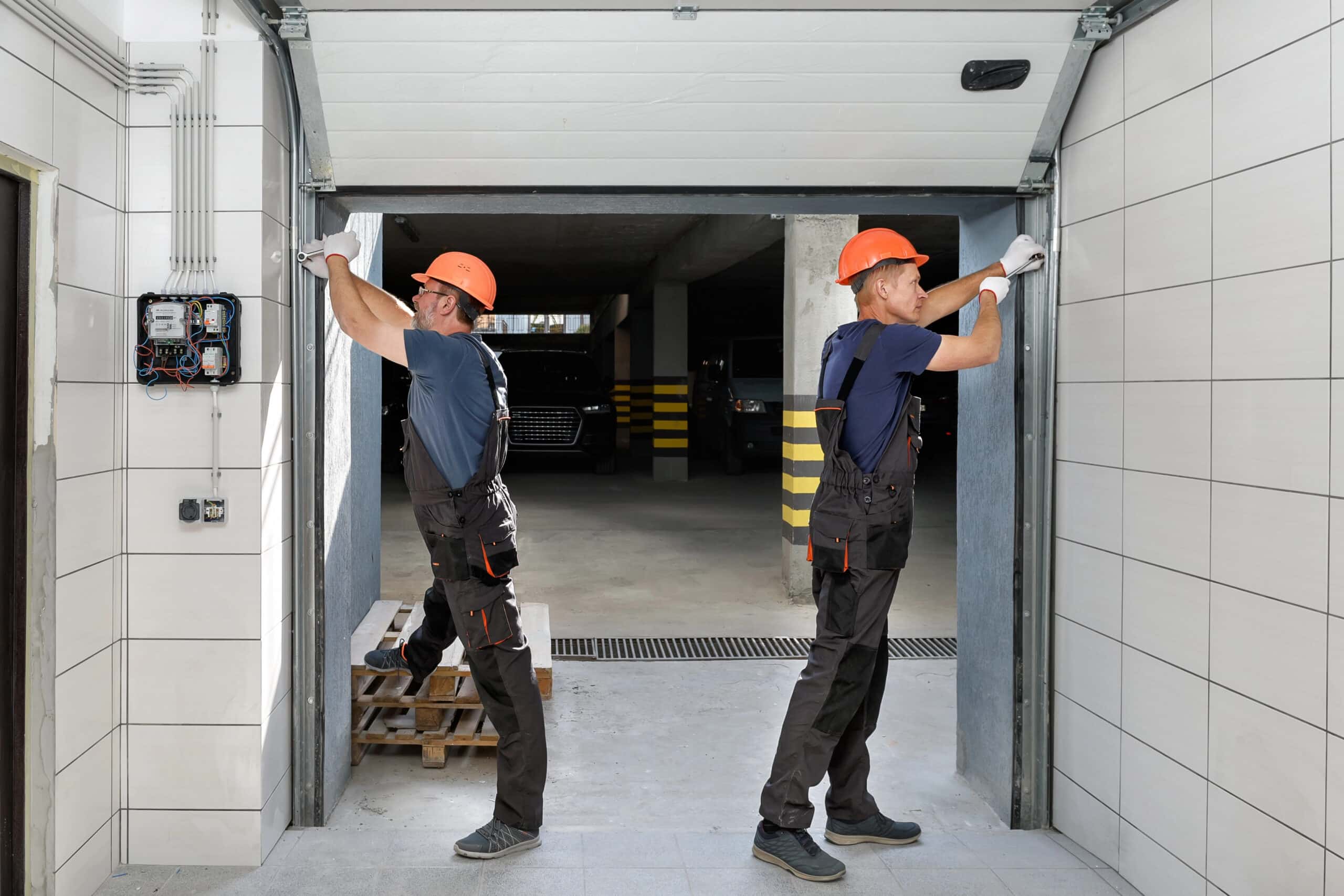
Key Takeaways
1. Overhead door safety checks should be performed monthly by your in-house team and annually by a certified technician, with detailed documentation.
2. The most critical safety checks for commercial overhead doors cover springs and cables, photo-eye sensors, auto-reverse mechanisms, door balance, and structural mounting hardware.
3. Quality Overhead Door provides comprehensive overhead door inspections, preventive maintenance contracts, and emergency repairs across Rochester and Southeast Minnesota for commercial, industrial, and agricultural facilities.
Why Overhead Door Safety Checks Matter for Commercial Buildings
A commercial overhead door is a moving wall. Many weigh several hundred pounds, open and close dozens to hundreds of times each day, and create the kind of struck-by and pinch-point hazards that OSHA citation files are full of.
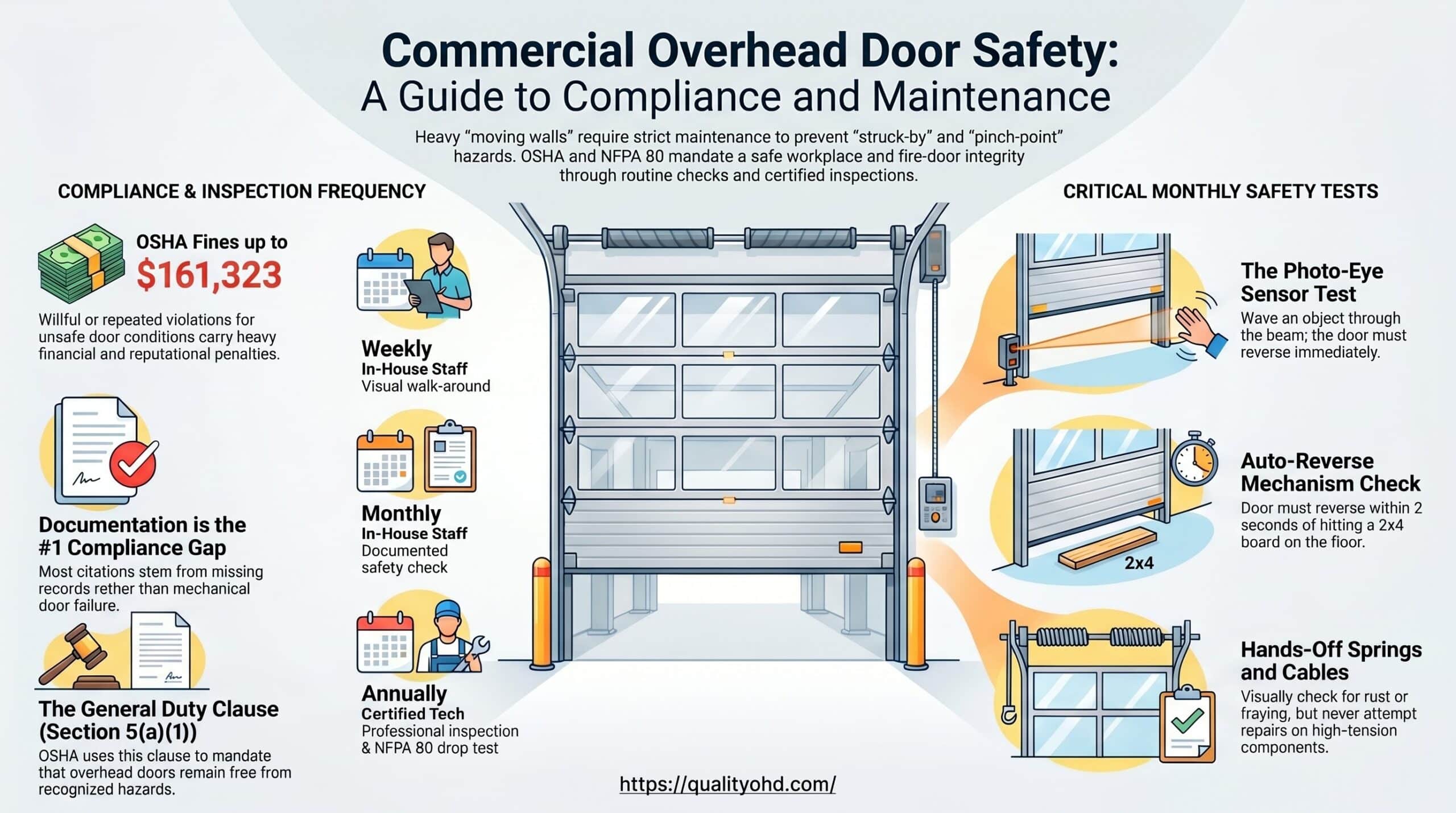
While OSHA does not have a regulation that names “overhead doors” specifically, commercial doors fall under the General Duty Clause (Section 5(a)(1)), which requires employers to provide a workplace “free from recognized hazards that are causing or likely to cause death or serious physical harm.” OSHA has cited businesses for missing photo-eyes, damaged reversing edges, and improperly maintained doors under this clause.
Beyond OSHA, insurance carriers, fire marshals (especially for NFPA 80 fire-rated doors), and property management contracts all require evidence of regular safety inspection and documentation. A well-run inspection program protects employees, prevents costly downtime, and creates the paper trail you need for any audit.
How Often Should Commercial Overhead Doors Be Inspected?
Inspection frequency depends on usage, environment, and door type. The standard framework most facility managers follow:
| Inspection Type | Performed By | Frequency |
|---|---|---|
| Visual walk-around | In-house maintenance | Weekly |
| Documented safety check | In-house maintenance or trained staff | Monthly |
| Comprehensive professional inspection | Certified technician | Quarterly to annually (depending on use) |
| NFPA 80 fire-rated door inspection | Qualified certified inspector | Annually (required by code) |
| Post-incident inspection | Certified technician | Immediately after any impact, near miss, or unusual operation |
High-cycle doors (loading docks, distribution centers, manufacturing plants with constant forklift traffic) should be professionally inspected quarterly. Standard commercial doors with moderate use need professional inspection once or twice a year.

Monthly Safety Check for Commercial Overhead Doors
The monthly safety check for commercial overhead doors is the work your facility team does between professional inspections. It does not require specialized tools. It does require consistency, documentation, and a willingness to call a technician when something fails.
1. Photo-Eye Sensor Test
Photo-eye sensors mounted 4 to 6 inches above the floor on either side of the opening must stop and reverse the door when their infrared beam is broken.
How to check: Start the door closing. Wave a broom handle through the beam path. The door should reverse immediately.
What to look for: Steady green or amber LED lights on both sensors. Flickering or dark LEDs indicate alignment or wiring issues.
2. Auto-Reverse Mechanism Test
The auto-reverse system catches obstructions that photo-eyes miss, such as objects below the beam height.
How to check: Place a 2×4 board flat on the floor in the door’s path. Close the door. It must contact the board, stop within 2 seconds, and reverse fully open.
What to look for: Decisive, immediate reversal. Hesitation or continued downward pressure means the force settings need adjustment by a certified technician.
3. Springs and Cables Visual Inspection
Torsion springs and lifting cables carry the full weight load. Failures are sudden, violent, and dangerous.
What to look for: Gaps in spring coils, rust, visible stretching, fraying or kinking cables, or cables coming loose from drums. Never attempt to adjust or repair springs or cables. These require trained technicians.
4. Tracks, Rollers, and Hinges
Misaligned tracks or worn rollers create binding that stresses every other component.
What to look for: Tracks plumb, free of dents or debris, securely mounted. Rollers turning smoothly without wobbles. Hinges with no cracks or missing fasteners.
5. Door Balance
A properly balanced door stays in place when the opener is disconnected and the door is manually positioned halfway open.
How to check: Pull the manual release cord. Lift the door to the halfway point. If it stays, balance is correct. If it falls or rises, springs need professional adjustment.
6. Hardware Tightness
All visible nuts, bolts, brackets, and mounting plates should be tight. Loose hardware is a leading cause of premature panel and track damage.
7. Opener and Controls
The opener should run smoothly without grinding. Wall buttons should activate consistently. Remotes should work from normal distances. Any unusual noise is a red flag.
8. Safety Edges and Pressure Sensors (Where Equipped)
Commercial doors often have pressure-sensitive safety edges that reverse the door on contact.
How to check: Close the door. Press firmly on the bottom edge as it descends. It should stop and reverse instantly.
9. Weatherstripping and Door Seal
Visual check of bottom, side, and top seals for cracks, gaps, or missing sections.
10. Warning Signage
OSHA expects clearly visible signage near the door warning of pinch points, moving parts, and pedestrian hazards. Verify signs are present, legible, and unobstructed.
What an Annual Professional Inspection of Overhead Doors Adds
Monthly checks catch most surface issues. A certified technician’s annual inspection catches problems that an internal team is not equipped to evaluate.
A comprehensive professional inspection includes everything in the monthly check plus:
- Force calibration testing with proper meters to confirm closing forces are within OSHA-acceptable ranges
- Spring tension assessment including cycle count estimation and replacement before failure
- Cable wear measurement beyond visible fraying
- Track alignment verification to tolerances most facility teams cannot measure
- Operator internal inspection for worn gears, belts, chains, or screws
- Electrical and wiring inspection including ground continuity and connection integrity
- NFPA 80 fire-rated door drop test for any door with a fire rating
For NFPA 80 fire-rated doors, the annual inspection is required by code. Drop tests must verify that the door closes and seats correctly under release. Documentation is required for fire marshal review.
Make sure your garage overhead doors are compliant with the regulations by having Quality Overhead Doors perform a professional inspection.
What Is the Most Common Non-compliance in Overhead Door
Research across commercial properties shows that the majority of building code violations stem from documentation gaps rather than actual safety deficiencies. A door can be perfectly safe but still generate a citation if no record exists proving regular inspection.
Effective overhead door safety check documentation includes:
- Date of each inspection
- Inspector name and signature
- Specific items checked and their condition
- Photos of any deficiencies found
- Corrective actions taken (or scheduled, with target completion dates)
- Verification that previous deficiencies were resolved
OSHA inspectors and insurance auditors expect retrievable, organized records. Paper checklists in a binder satisfy the requirement, but digital records with timestamped photos retrieve faster and survive staff turnover. For facilities with multiple buildings or door types, a centralized maintenance management system is worth the investment.
How Quality Overhead Door Supports Rochester-Area Facility Managers
Maintaining a defensible overhead door safety program requires more than a checklist. It requires a certified service partner who understands OSHA, NFPA, and DASMA requirements and can document compliance to the standard that auditors expect.
Quality Overhead Door has served Rochester and Southeast Minnesota since 1981. As a Raynor Door Authority company, we provide:
- Scheduled preventive maintenance contracts with monthly, quarterly, or semi-annual visit options
- Comprehensive annual inspections for commercial, industrial, and agricultural facilities
- NFPA 80 fire-rated door inspections and drop tests with full documentation
- 24/7 emergency repair service for urgent failures, including weekends and holidays
- Detailed written reports suitable for OSHA, insurance, and fire marshal review
- Certified Raynor and LiftMaster technicians trained on every major commercial system
Whether you manage a single warehouse or a multi-building portfolio, we tailor inspection schedules to your usage patterns, compliance requirements, and budget.
What You Should Do Next
- Audit your current inspection schedule. If your facility has no documented monthly checks or has not had a professional inspection in the past year, that gap needs to close.
- Centralize documentation. Whether digital or paper, every safety check needs a date, a signature, and a record of findings and corrective actions.
- Contact Quality Overhead Door to schedule a baseline professional inspection or set up a preventive maintenance contract. Call 507-281-2772 or visit our facility at 128 35th St SE in Rochester.